How to Get on the First Page of Google | The Exact 2026 Roadmap to Dominate Google’s First Page (And Stay There)
If your business isn’t on the first page of Google, you’re essentially invisible. With over 91% of all clicks going to Page 1 results, every day spent on Page 2 or beyond is revenue walking straight into your competitor’s pocket.
But here’s what most SEO guides won’t tell you: Page 1 in 2026 looks completely different from what it did even two years ago. AI Overviews are eating organic clicks. Zero-click searches are rising. And Google’s algorithm now demands something no hack or shortcut can fake — genuine expertise, real authority, and content that truly satisfies the searcher.
This guide gives you the complete, honest, and actionable roadmap on How to Get on the First Page of Google built on Trafficly’s battle-tested Rank Hunter Framework — not just to reach Page 1, but own it.
Quick Answer
To get on the first page of Google in 2026, you need to align your content with exact search intent, pass all Core Web Vitals thresholds, build E-E-A-T signals through original expertise, optimise for AI Overviews with structured data, and earn authoritative backlinks. For local UK businesses, a fully optimised Google Business Profile is non-negotiable.
📞 Ready to rank — without the guesswork? Trafficly’s SEO specialists have helped UK businesses dominate Page 1 consistently.
The 2026 Search Reality: “Page 1” Has Changed Forever
Before diving into tactics, you need to understand the landscape you’re actually competing in.
Google’s search results page in 2026 is no longer just ten blue links. The top of the page is now dominated by AI Overviews (AIOs) — Google’s AI-generated answer summaries powered by Gemini. Below that sit Featured Snippets, People Also Ask (PAA) boxes, local Map Packs, and Shopping results. Organic links? They’re further down than ever.
This means the game has shifted. Ranking #1 is no longer the ultimate goal — becoming the primary cited source for AI-generated answers is. This is what separates businesses that get traffic from those that get buried.
A modern first-page Google result now demands broader search visibility across multiple placements, not just a single organic ranking. Here’s what dominant Page 1 presence looks like in practice:
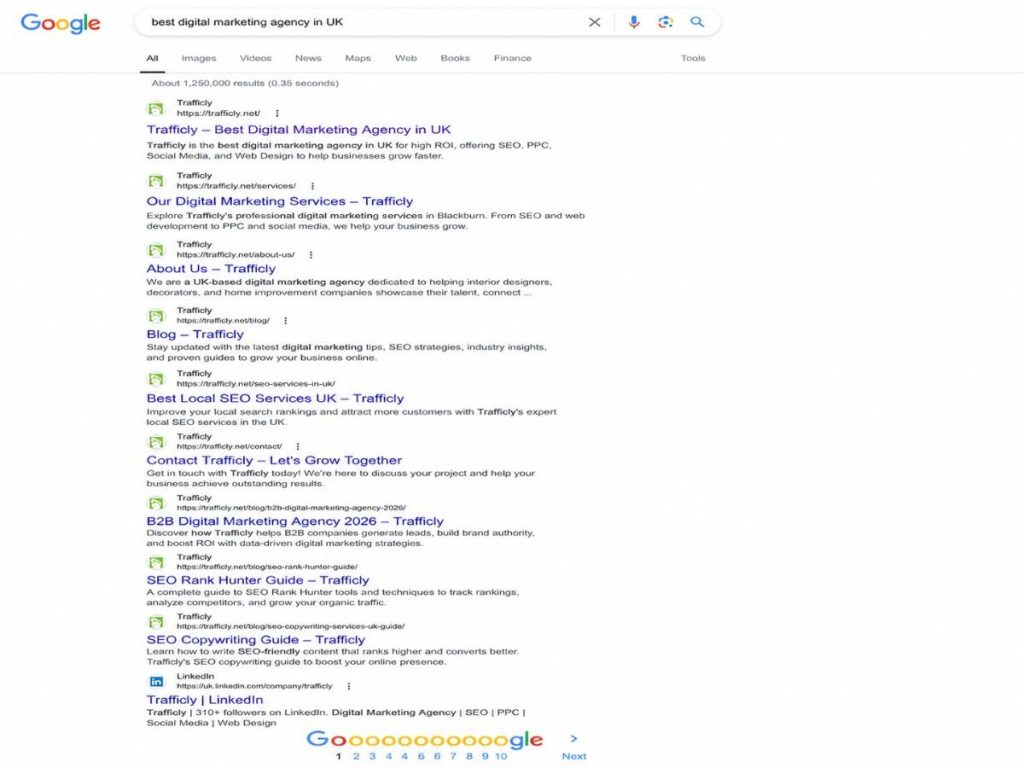
Google now measures success not by your position but by something called Query Satisfaction Score — essentially, did the user get everything they needed from your page and stop searching? If they did, your page gets rewarded. If they bounced back to Google immediately (a “pogo stick” behaviour), your ranking drops.
This is why thin, generic content is dying. And why deeply helpful, experience-backed content is winning more than ever.
Phase 1 — Decoding Search Intent & Building Semantic Foundations
Why Intent Beats Keywords Every Single Time
Most businesses start with a keyword. Smart businesses start with a question: “What does this person actually need when they type this?”
Search intent sits in four categories — informational, navigational, commercial, and transactional. But in 2026, Google has gone deeper. It now recognises micro-intent — the specific sub-problem a user is trying to solve within a broader topic.
For example, someone searching “how to get on the first page of Google” isn’t just looking for a definition. They want a step-by-step, actionable plan they can implement right now. That micro-intent distinction changes everything about how you write and structure your content.
Topic Clusters: The Architecture of Topical Authority
Ranking a single page is increasingly difficult without topical authority — Google’s trust that your entire website is an expert on a subject, not just one article.
This is why Trafficly builds content using a hub-and-spoke model:
- Hub page (like this one): The comprehensive, definitive guide on the main topic.
- Spoke pages: Deeper dives into sub-topics — keyword research, technical audits, local SEO, link building — all linking back to the hub.
When Google crawls your site and sees ten interconnected, expert-level pieces all covering different angles of the same subject, it classifies your domain as a topical authority — and rewards you accordingly.
As we covered in our guide to finding easy-to-rank keywords with the SEO Rank Hunter, keyword intent and volume are just the starting point. The real advantage lies in building clusters around every question your audience is asking.
LSI & Semantic Signals — Writing for How Google Thinks
Google no longer reads pages word by word. It reads them semantically — understanding contextual relationships between concepts, identifying whether you’ve covered the full breadth of a topic, and checking for semantic relevance gaps.
This means your content must naturally include related terms, synonyms, and connected concepts. Not stuffed — woven in through genuinely helpful writing. Tools like Surfer SEO, Clearscope, or even a careful read of Google’s “Related Searches” will reveal the semantic gaps you need to fill.
Phase 2 — Technical Integrity: The Non-Negotiable Foundation
No amount of brilliant content will rank on a broken or slow website. Technical SEO is the foundation everything else sits on — and in 2026, Google’s Core Web Vitals are stricter than ever.
The Three Core Web Vitals You Must Pass
1. Largest Contentful Paint (LCP) — How fast does your main content visually load? Google wants this under 2.5 seconds. Compress images, use a CDN, and eliminate render-blocking scripts.
2. Interaction to Next Paint (INP) — Replaced FID in 2024. This measures how quickly your page responds to user interactions like button clicks. Poor INP tanks engagement signals. Target under 200ms.
3. Cumulative Layout Shift (CLS) — Does your page jump around while loading? Those annoying layout shifts destroy user experience and Google’s trust. Keep your CLS score under 0.1.
Site Architecture & Crawlability
Even if your content is outstanding, Google needs to actually find and index it. A clean site architecture — with a logical hierarchy, an XML sitemap, proper internal linking, and no orphaned pages — ensures every page you publish gets crawled and considered for ranking.
Schema Markup is your secret weapon here. By implementing structured data (FAQ schema, HowTo schema, Organisation schema), you’re speaking Google’s language and significantly increasing your chances of appearing in rich results, PAA boxes, and AI Overviews.
Trafficly’s web development services are built with Page Experience at their core — so your site passes every technical threshold before your content even goes live.
🔧 Is your website holding your rankings back?
Phase 3 — Crafting Helpful Content: The Human Signal Google Rewards
Here’s the truth Google won’t say publicly but its algorithm makes it obvious: it can tell when content was written by a human with real experience and when it wasn’t.
E-E-A-T in 2026: Experience Is Now the Most Important Letter
Google’s quality evaluator guidelines emphasise Experience, Expertise, Authoritativeness, and Trustworthiness (E-E-A-T). The first E — Experience — was added specifically because Google wants content written by people who have actually done the thing they’re writing about.
This means your SEO content needs:
- First-hand case studies with real data and outcomes
- Named authors with verifiable credentials and a visible online presence
- Original insights that go beyond what’s already published elsewhere
- Transparent sourcing — citing your data, your tools, your methodology
This is what creates Information Gain — the quality signal Google uses to measure how much new, useful knowledge your page adds to the internet. The higher your information gain, the stronger your ranking potential.
SEO Copywriting: Writing for Humans First, Algorithms Second
The best-ranking content in 2026 reads like it was written by a trusted expert speaking directly to the reader — because it was. Keyword placement matters, but natural language flow matters more.
Structure your content with:
- Clear, benefit-driven H2 and H3 subheadings that answer questions before the reader even finishes reading them
- Short paragraphs (2–4 lines max) for mobile readability
- Bullet points and numbered lists for scannable, snippet-friendly formatting
- Bold key statements to anchor attention and aid comprehension
Our SEO copywriting services are built on exactly this principle — content that satisfies the reader, earns Google’s trust, and drives real conversions.
Phase 4 — Dominating AI Overviews: Generative Engine Optimisation (GEO)
This is the frontier most SEO guides aren’t talking about yet — and it’s where the biggest opportunity lies in 2026.
What Is GEO and Why Does It Matter?
Generative Engine Optimisation (GEO) is the practice of structuring and writing your content so it gets cited by AI-powered search tools — Google’s AI Overviews, ChatGPT’s search, Perplexity, and others.
Being cited in an AI Overview is the new “Position Zero.” It puts your brand name in front of thousands of searchers even when they don’t click through. It builds brand authority. And increasingly, it drives direct navigational searches — people Googling your brand name because they saw it referenced by AI.
How to Get Cited by Google’s AI
- Answer questions directly and concisely in the first paragraph of each section — AI systems extract clean, direct answers
- Use FAQ schema and HowTo schema to make your structured answers machine-readable
- Write with cite-worthy specificity — include statistics, named frameworks, and original terminology
- Earn mentions on authoritative platforms — Reddit threads, LinkedIn articles, and niche industry forums all feed into the trust signals AI systems use when selecting sources
- Use clear, logical structure — AI models favour content with unambiguous headings that match common search queries
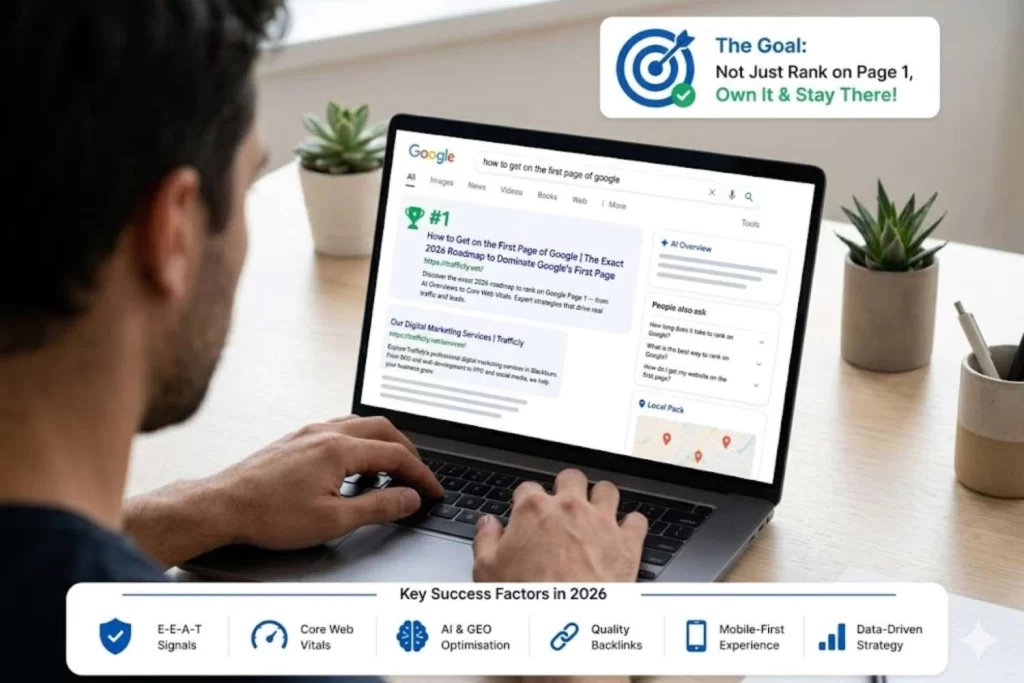
Phase 5 — Local Authority: Dominating UK Search Results
For UK-based businesses, local SEO is one of the highest-ROI strategies available — and in 2026, it’s more sophisticated than ever.
Google Business Profile: Your Local Ranking Engine
Your Google Business Profile (GBP) is directly tied to your visibility in the local Map Pack — those three business listings that appear above organic results for location-based searches. Optimising it means:
- Complete and consistent NAP (Name, Address, Phone) details across all directories
- Regular posts and updates to signal activity
- Actively collecting and responding to Google Reviews (review velocity directly impacts local rankings)
- Adding geo-tagged photos and service-specific categories
- Utilising the Q&A section with keyword-rich answers
For businesses targeting cities like Manchester, Preston, or anywhere across the UK, location-specific landing pages — each crafted around local search intent — dramatically increase your geo-targeted visibility.
Our SEO Services in Manchester are specifically designed for UK businesses ready to own their local search territory.
Phase 6 — Off-Page Authority: From Link Building to Brand Building
The old SEO playbook said: “Get as many backlinks as possible.” The 2026 playbook says: “Become a brand that people naturally reference and cite.”
Digital PR Over Directory Spam
Google’s link quality assessment has become forensically accurate. A handful of genuine, editorially earned links from relevant, authoritative publications now outweighs hundreds of low-quality directory links. Focus on:
- Digital PR campaigns — newsworthy data, studies, or expert commentary that journalists want to cover
- Guest contributions on respected industry sites with real audiences
- Podcast appearances and expert roundups that build brand mentions alongside links
- LinkedIn thought leadership — well-argued posts that earn shares, comments, and citations
- Community engagement on Reddit in relevant subreddits — Google actively monitors these for brand authority signals
As we explore in our 2026 SEO trends and business news blog, the brands winning in search aren’t just optimising pages — they’re building digital reputations that algorithms trust.
Phase 7 — Measuring What Actually Matters in 2026
Reaching Page 1 is the goal. Staying there and converting that traffic into revenue is the mission.
Beyond Rankings: The Metrics That Drive Growth
- Organic Click-Through Rate (CTR): Even at Position 1, a weak meta title and description bleeds clicks. Test and refine your SERP snippets regularly.
- Bounce Rate & Dwell Time: How long do users stay? Do they explore other pages? These engagement signals directly influence your sustained ranking.
- Conversion Rate from Organic Traffic: Traffic means nothing without leads. Your page architecture, CTAs, and trust signals must turn visitors into enquiries.
- AI Overview Citation Rate: Are you being cited? Monitor brand mentions across AI tools and track referral traffic from AI-generated answers.
PPC as a Page 1 Shortcut While Organic Matures
SEO is a long game — typically 4–6 months before significant organic movement. But that doesn’t mean you have to wait for leads. Google Ads PPC puts you at the top of Page 1 immediately, generating leads while your organic authority builds in parallel.
Trafficly’s PPC management services are built for exactly this — intelligent paid campaigns that deliver ROI now, not later.
Want Page 1 results — both immediately and long-term? Let’s build your complete 2026 search strategy together.
Frequently Asked Questions
How long does it take to get on the first page of Google in 2026?
For competitive keywords, expect 4–9 months of consistent SEO work. For long-tail, lower-competition keywords, results can appear in 4–8 weeks. Local SEO results — particularly Google Map Pack — can move faster, sometimes within 2–6 weeks with a fully optimised GBP and local citation strategy.
Does AI-generated content rank on Google?
Google’s stance is clear: it rewards helpful content regardless of how it was produced. However, purely AI-generated, unedited content typically fails E-E-A-T requirements because it lacks first-hand experience and original insight. The winning formula is AI-assisted, human-refined content — using AI for efficiency, human expertise for authenticity and depth.
Why did my website drop from the first page of Google?
The most common causes are: a Google core algorithm update devaluing thin content, a technical issue (site speed regression, crawl errors, manual action), a competitor significantly improving their content and authority, or a loss of backlinks. A thorough SEO audit is always the first step in diagnosing and recovering a ranking drop.
Is SEO dead in the age of AI?
Absolutely not — but it has evolved. SEO in 2026 is about being the source AI trusts, not just the link a human clicks. Brands that invest in genuine authority, structured data, and helpful content are gaining more visibility than ever — across both traditional search and AI-generated answers.
What is the single most important ranking factor in 2026?
If forced to choose one: demonstrated topical authority backed by E-E-A-T signals. Google wants to identify the most trustworthy, experienced source for any given topic. Build that reputation through consistent, original, deeply helpful content — and the rankings follow.
Do I need backlinks to rank on Page 1?
For competitive queries, yes — backlinks remain a significant trust signal. But the nature of effective link building has changed. One link from a genuinely authoritative, relevant publication is worth more than 100 low-quality directory links. Focus on earning links through merit: original research, expert commentary, and content worth citing.
Ready to Claim Your Place on Page 1?
Ranking on Google’s first page in 2026 isn’t about tricks, shortcuts, or gaming an algorithm. It’s about building a digital presence so genuinely useful, authoritative, and technically sound that Google has no choice but to trust you.
That’s exactly what Trafficly does — for UK businesses ready to compete at the highest level.
Whether you’re starting from scratch, recovering from a ranking drop, or ready to scale beyond Page 1 into AI Overviews and featured positions, our team has the expertise, the tools, and the proven framework to get you there.
Let’s Get You on Page 1 — Starting Today
Free SEO Audit. No Obligation. Real Answers.
Trafficly is a results-driven digital marketing agency in the UK, specialising in SEO, PPC, and web development for ambitious businesses ready to grow.
