
Advanced Ecommerce PPC Services That Actually Outsmart Your Biggest Competitors
Running an online store in 2026 without a smart PPC strategy is like opening a shop on a side street and hoping customers find you. Meanwhile, your competitors are running full-page adverts on the high street — and they’re winning.
The truth? Most ecommerce brands are spending money on PPC, but very few are spending it strategically. Generic keyword bidding, poorly structured campaigns, and zero data intelligence are quietly draining thousands of pounds every month — with little to show for it.
Advanced ecommerce PPC services in 2026 are a completely different game. When done right, they can reduce your cost-per-click (CPC) by up to 40%, dramatically improve your Return on Ad Spend (ROAS), and put your products directly in front of customers who are ready to buy — not browse.
This guide is your complete deep-dive: covering everything from intelligent competitor intelligence and product feed optimisation to Performance Max campaigns, dynamic remarketing, and conversion-focused landing pages. Whether you’re a growing UK ecommerce brand or scaling to international markets, this is the roadmap you’ve been looking for.
Ready to stop guessing and start winning?
Call us today on 0843 289 3468 or email info@trafficly.net
What Are Ecommerce PPC Services And Why Standard Ads Aren’t Enough Anymore
Pay-per-click advertising for ecommerce is not simply “running Google Ads.” True ecommerce PPC services are a fully engineered system — combining strategic keyword research, product feed optimisation, audience segmentation, AI-driven bidding, A/B tested ad creative, and conversion rate optimisation (CRO) into one cohesive revenue machine.
Here’s the critical problem most brands face: they run ads, but they don’t run strategy. They pick a handful of obvious keywords, set a daily budget, and hope the algorithm figures the rest out. It doesn’t.
In 2026, the landscape of modern ecommerce advertising has completely shifted. Google’s algorithms are smarter, competition is more intense, and consumer expectations are higher than ever. Static shopping ads with no audience layering or feed optimisation simply can’t compete with the brands that are using Performance Max (PMax), first-party data, server-side tracking, and dynamic remarketing simultaneously.
The brands that are winning are not just advertising — they are engineering growth. And that’s exactly what professional ecommerce PPC services deliver.
Strategic Keyword Research for Online Stores: Beyond Broad Terms
The biggest waste in ecommerce PPC? Broad, non-specific keywords that attract the wrong traffic.
Searching for “shoes” costs a fortune. But targeting “buy waterproof walking boots size 10 UK” puts your product in front of someone actively reaching for their wallet.
Effective ecommerce PPC services begin with deep search intent analysis — separating informational queries (people researching) from transactional queries (people buying). Your ad budget should be almost entirely focused on transactional, high-intent product queries.
The right keyword strategy includes:
- Long-tail product queries — highly specific phrases with lower CPC and higher conversion rates
- Negative keyword lists — ruthlessly filtering out irrelevant traffic that burns your budget without converting (terms like “free,” “DIY,” “how to make,” etc.)
- Competitor conquesting keywords — strategically bidding on competitor brand terms to capture their dissatisfied audience
- Seasonal and trending terms — capitalising on demand spikes with proactive keyword planning
Before a single pound of ad spend is committed, professional keyword research forms the absolute foundation. Understanding what your specific customers are actually searching — not what you think they search — is what separates profitable campaigns from expensive experiments.
And here’s the extra layer most agencies ignore: keyword research must be paired with search intent analysis at the product level. Each product category deserves its own keyword cluster, its own negative keyword list, and its own bidding strategy.
Mastering Competitor Intelligence — Don’t Just Run Ads, Outsmart the Competition
Advanced ecommerce PPC isn’t played in isolation. Your competitors are bidding on the same keywords, showing up in the same Google Shopping results, and chasing the same customers. The question is: do you know exactly what they’re doing?
Serious ecommerce PPC services include dedicated competitor intelligence as a core function — not an afterthought.
Here’s how it works in practice:
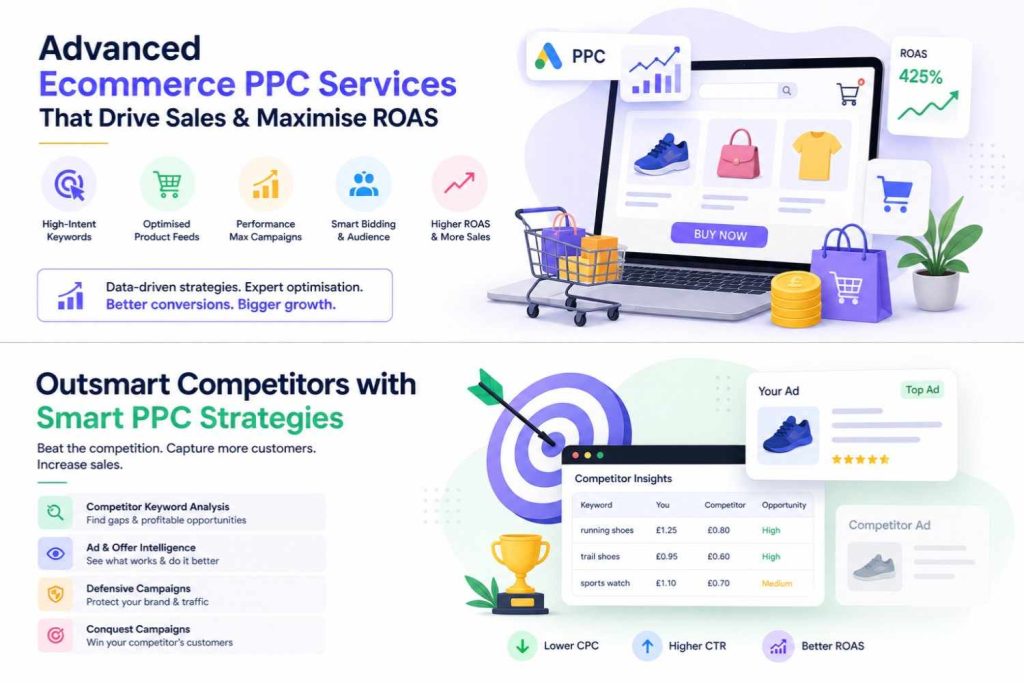
1. Identify Competitor Keyword Gaps
Using tools like SEMrush or SpyFu, identify high-converting keywords your competitors are bidding on that have lower competition. These are your golden opportunities — keywords where you can enter the auction at a lower CPC and still win top placement.
2. Audit Competitor Ad Creative
The Google Ads Transparency Centre and Meta Ad Library give you direct visibility into your competitors’ live ad copy, offers, and messaging. What are they promising? Free shipping? Urgency messaging? Price guarantees? Understanding what’s resonating in your market means you can craft ads that are better — not just different.
3. Defensive Campaigning
Google Ads Auction Insights reveals when competitors are bidding on your own brand name. The response? Launch defensive brand campaigns that protect your market share, appear above competitor ads for your own branded terms, and recapture traffic that is rightfully yours.
4. Conquest Campaigns
Strategically appear when potential customers search for your direct competitors. Done correctly and compliantly, conquest campaigns can poach high-intent buyers at the moment they’re actively considering alternatives.
This level of intelligence is not available through a self-managed Google Ads account. It requires expertise, the right tools, and an experienced ecommerce PPC team — which is exactly what Trafficly provides.
Is Your Ecommerce PPC Strategy Leaving Money on the Table?
Get a FREE PPC audit from Trafficly’s experts.
We’ll identify exactly where your budget is being wasted and show you how to turn it into revenue. 📧 info@trafficly.net | 📞 0843 289 3468
Mastering the Technical Side: Product Feeds, Tracking & GA4 Integration
This is where most ecommerce brands fall apart — and where the best ecommerce PPC services create the biggest competitive advantage.
Product Feed Optimisation
Your Google Shopping campaigns are only as good as your product feed. A poorly structured feed with missing attributes, weak titles, or low-quality images means your products appear lower in results, cost more per click, and convert less. A professionally optimised feed does the opposite.
Key product feed improvements include:
- Keyword-rich product titles that match search queries
- Accurate product categories and Google product taxonomy mapping
- High-resolution imagery that compresses fast and looks sharp on mobile
- Real-time price and availability syncing through Google Merchant Centre
- Custom labels for campaign segmentation (high margin, bestseller, clearance)
Server-Side Tracking
Browser-based tracking is dying. Safari’s ITP, Firefox’s tracking protection, and ad-blocker usage means that a significant percentage of your conversions are going unmeasured — which means your bidding AI is flying blind.
Server-side tracking (using solutions like Tracklution or Google’s sGTM) captures conversion signals that browser-based tracking misses, giving your campaigns dramatically more accurate data to optimise against. More accurate data = smarter bidding = better ROAS.
GA4 Integration
Connecting GA4 to your Google Ads account creates a closed feedback loop between your website behaviour data and your campaign bidding. This integration enables:
- Audience building from real on-site behaviour
- Enhanced conversion tracking including micro-conversions
- Cross-channel attribution modelling
- Lifetime value (LTV) data feeding back into Smart Bidding
These technical foundations aren’t optional for serious ecommerce advertisers — they’re essential. If you haven’t already, auditing your website’s technical health is the critical first step before spending a single penny on ads.
Performance Max & Advanced Campaign Architecture
Google’s Performance Max (PMax) is the most powerful — and most misunderstood — campaign type available to ecommerce advertisers in 2026.
PMax serves ads across Google’s entire inventory: Search, Shopping, Display, YouTube, Gmail, and Maps — all from a single campaign. The AI finds new converting customers across every channel, at the right moment, using the right format.
But here’s what most brands get wrong: PMax is only as smart as the inputs you give it. Weak creative assets, no audience signals, and poor conversion data produce mediocre results. Feed it strong signals and high-quality assets, and it becomes your most efficient growth driver.
A winning PMax strategy includes:
- Strong audience signals from your CRM and first-party data
- A full creative asset group: multiple headlines, descriptions, images, and video assets
- Exclusion of branded terms (handle these in separate campaigns)
- Supplementary standard Shopping campaigns for granular control
- Regular asset group performance reviews and pruning
Campaign Architecture for Maximum Profitability:
Rather than dumping all products into one Shopping campaign, advanced ecommerce PPC services use a priority-tiered structure:
- High Priority Campaign — captures branded, high-intent queries with high bids
- Medium Priority Campaign — targets category-level queries
- Low Priority Campaign — catches broad, generic discovery queries at low CPC
This structure ensures you’re not paying premium bids for generic traffic while still maintaining visibility across the funnel.
Dynamic Remarketing: Turning Browsers Into Buyers
The harsh reality of ecommerce: approximately 97% of first-time visitors do not purchase on their first visit. Dynamic remarketing is how you bring them back — and convert them.
Unlike static display ads, dynamic remarketing campaigns serve ads that automatically feature the exact products a user viewed, added to cart, or interacted with — but didn’t buy. These hyper-personalised ads follow users across Google’s Display Network, YouTube, and partner sites, keeping your brand and products front of mind.
Why it works:
- A user who viewed a product is 70% more likely to convert when shown a dynamic ad featuring that exact product
- Cart abandonment campaigns with urgency messaging (“Only 3 left!”) recover significant lost revenue
- Cross-sell campaigns target existing customers with complementary products, increasing average order value (AOV)
Segmenting your remarketing audiences properly is critical:
- Cart abandoners — highest intent, most aggressive bids
- Product page viewers — mid-funnel, benefit-focused messaging
- Past purchasers — loyalty-driven cross-sell campaigns
- All site visitors (30 days) — broad brand awareness, lower bids
Ad Creative That Drives Clicks and Converts
Even the most technically perfect campaign structure fails without compelling ad creative. In 2026, ad creative is not just about good design — it’s about message-to-market match and benefit-driven copywriting.
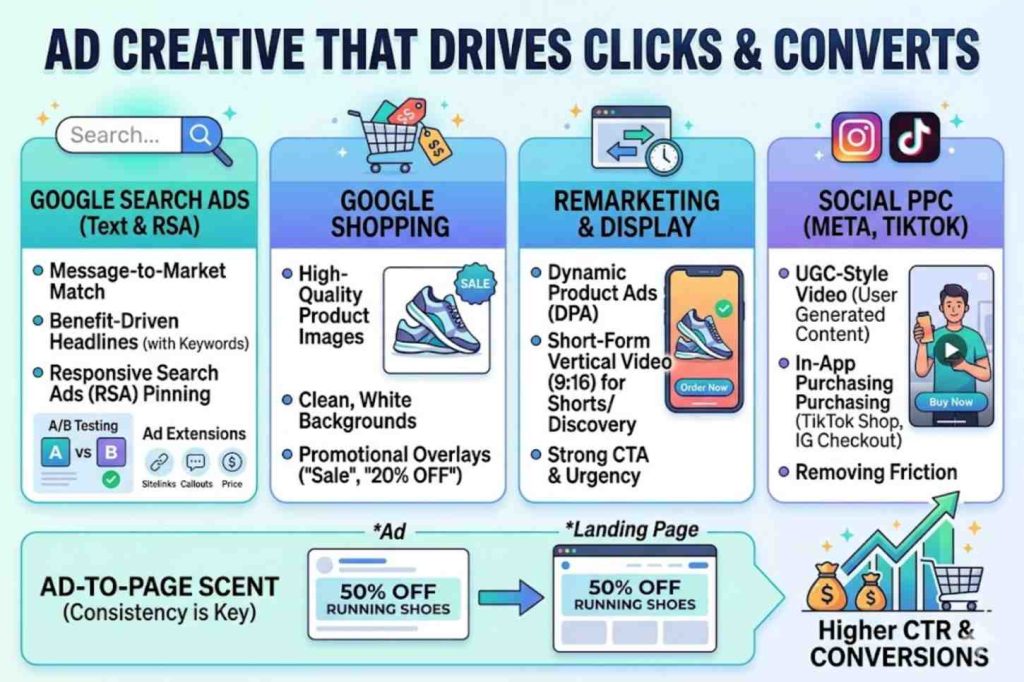
For Google Search Ads:
- Lead with the customer’s desired outcome, not your product features
- Include your primary keyword in the headline naturally
- Use RSA (Responsive Search Ad) pinning to control which combinations appear
- A/B test ad copy systematically — run at least two variants per ad group and wait for statistical significance (minimum 100 conversions) before declaring a winner
- Use ad extensions aggressively: sitelinks, callouts, structured snippets, price extensions, and promotion extensions all improve CTR
For Google Shopping:
- Your product image is your most important creative asset
- Clean, white-background images with multiple angles outperform lifestyle shots in Shopping results
- Promotional overlays (“Sale,” “20% Off”) significantly lift CTR
For Remarketing Display:
- Dynamic product ads with clear pricing, urgency, and a strong CTA
- Short-form vertical video (9:16 ratio) for YouTube Shorts and discovery — delivering up to 1.5x higher CTR than static display
For Social PPC (Meta, TikTok):
- UGC-style (user-generated content) video dramatically outperforms polished brand video for direct response
- TikTok Shop and Instagram Checkout allow in-app purchasing, removing friction from the conversion path entirely
Remember: your ad is only half the equation. The landing page experience must match your ad’s promise exactly — this is what we call ad-to-page scent. If your ad says “50% off running shoes,” the landing page must instantly confirm that offer. Any disconnect kills conversions.
Landing Page Essentials: The Final Step in the Conversion Funnel
You could be running the most perfectly optimised PPC campaigns in the UK — and still lose money if your landing pages aren’t built for conversion.
This is where many ecommerce brands fail. They invest heavily in ad strategy but send paid traffic to generic category pages or a cluttered homepage. The result? High spend, low conversion rate, poor ROAS.
A conversion-optimised ecommerce landing page must:
- Reflect the ad promise immediately — above the fold, with zero confusion
- Load in under 2 seconds — every second of delay reduces conversions significantly
- Display trust signals prominently — reviews, star ratings, secure checkout badges, and return policies
- Offer a frictionless path to purchase — minimal clicks from ad click to checkout
- Be fully optimised for mobile — over 60% of UK ecommerce traffic is now mobile
The interplay between PPC and CRO is inseparable. Getting this right is the difference between a campaign that breaks even and one that delivers 5x ROAS. If you want to understand how we approach this holistically, our Conversion Rate Optimisation guide covers the full picture.
Combining strong PPC with a well-optimised landing page is also the foundation of dominating the Google SERP — owning both the paid and organic positions simultaneously for maximum brand authority.
Advanced Scaling: From Small Budget to National & Global Reach
Starting small and scaling smart is the Trafficly approach. You don’t need a £50,000/month budget to see serious results — but you do need a clear scaling roadmap.
Phase 1 — Foundation (£1,000–£3,000/month ad spend)
Focus on your most profitable product categories. Tighten keyword targeting. Build your conversion tracking infrastructure. Establish your baseline ROAS.
Phase 2 — Growth (£3,000–£10,000/month ad spend)
Expand to Performance Max. Layer in dynamic remarketing. Begin audience testing with first-party data. Introduce multi-channel (Bing/Microsoft Ads can offer lower competition and solid ROI — here’s why Bing often outperforms Google Ads for certain ecommerce categories).
Phase 3 — Scale (£10,000+/month ad spend)
International expansion. Profit-focused bidding using CLV data. AI-assisted optimisation tools (Optmyzr, Adalysis). Local Inventory Ads if you have physical locations. Voice search optimisation for conversational queries.
At this stage, Customer Acquisition Cost (CAC) becomes your north star metric alongside ROAS. As you scale, maintaining or improving CAC while expanding reach is the hallmark of a truly high-performance ecommerce PPC operation.
Measuring What Matters: Profit, LTV & Beyond Vanity Metrics
Clicks and impressions don’t pay the bills. Profit does.
Advanced ecommerce PPC services move beyond surface-level metrics to focus on what genuinely drives business growth:
| Metric | Why It Matters |
| ROAS (Return on Ad Spend) | Revenue generated per £1 of ad spend |
| CAC (Customer Acquisition Cost) | Total cost to acquire one paying customer |
| LTV (Lifetime Value) | Total revenue a customer generates over their relationship with your brand |
| Profit per Conversion | Revenue minus COGS minus ad spend — the real number |
| Impression Share Lost (Budget) | Identifies missed opportunity due to underfunding |
| Quality Score | Google’s rating of ad relevance — directly impacts CPC |
The shift from ROAS-focused to profit-focused bidding is one of the most powerful changes an ecommerce brand can make. By feeding CRM data back into Smart Bidding (via enhanced conversions or value rules), you can instruct Google’s algorithm to prioritise customers with the highest predicted lifetime value — not just the cheapest clicks.
This is the level of sophistication that separates £5k/month in wasted ad spend from £50k/month in compounding, profitable growth. And it’s precisely what Trafficly’s ecommerce PPC services deliver.
Also keep in mind — staying ahead of Google’s algorithm updates in 2026 directly affects how your PPC and organic presence work together. A combined strategy protects your brand when one channel fluctuates.
Frequently Asked Questions
Q: What are ecommerce PPC services?
Ecommerce PPC services are professionally managed pay-per-click advertising campaigns specifically designed for online stores. They include everything from Google Shopping and Performance Max to dynamic remarketing, product feed optimisation, and data-driven bidding strategy — all engineered to maximise sales and ROAS.
Q: How much should I spend on ecommerce PPC?
There is no universal answer, but most ecommerce businesses see meaningful results starting from £1,000–£2,000/month in ad spend. The key is not how much you spend — it’s how strategically you spend it. A well-managed smaller budget consistently outperforms a mismanaged larger one.
Q: How long before I see results from ecommerce PPC?
Unlike SEO, PPC can generate traffic within hours of launch. However, campaigns typically need 4–8 weeks of data to optimise properly and reach peak efficiency. We recommend committing to a minimum 3-month window for accurate performance assessment.
Q: What is a good ROAS for ecommerce PPC?
Industry benchmarks suggest a ROAS of 3:1 to 5:1 is solid for most ecommerce categories — meaning £3–£5 in revenue for every £1 spent on ads. However, your target ROAS should be calculated based on your specific margins, not industry averages.
Q: Do you manage Google Shopping and Performance Max campaigns?
Absolutely. Trafficly’s ecommerce PPC services cover the full Google Ads ecosystem — Search, Shopping, Performance Max, Display, and YouTube — as well as Microsoft/Bing Ads and paid social for a complete multi-channel strategy.
Q: What makes Trafficly different from other PPC agencies?
We are a results-driven UK digital marketing agency that combines technical expertise with genuine commercial understanding. We don’t just manage campaigns — we engineer growth. Every decision is anchored in your profit margins, not just clicks and impressions.
Ready to Outsmart Your Competitors and Scale Your Ecommerce Revenue?
If you’re an ecommerce brand in Blackburn or anywhere across the UK and you’re tired of ad spend that doesn’t deliver, it’s time for a smarter approach.
Trafficly’s ecommerce PPC specialists build campaigns that are engineered to convert — from the keyword strategy and product feed, all the way through to the landing page and profit reporting. No fluff. No guesswork. Just measurable, scalable growth.
Call us now: 0843 289 3468
Email us: info@trafficly.net
Don’t let another month of ad spend go to waste. Your competitors aren’t waiting — and neither should you.
