
Stop Losing Leads: The Definitive Guide to Technical SEO Audit Services in the UK
Every UK business invests in content, ads, and branding to attract visitors. Yet many websites quietly lose potential customers before they ever convert. The reason is rarely visible on the surface. Hidden technical issues inside the website’s infrastructure silently block search engines, slow down pages, and create poor user experiences.
This is where Technical SEO Audit Services become critical. A professional technical audit examines the underlying architecture of a website to ensure search engines can crawl, understand, and rank it properly. Without that foundation, even excellent content struggles to appear in search results.
In competitive UK industries, where users expect fast and seamless experiences, technical performance often determines whether visitors stay or leave. Businesses that regularly review their technical SEO infrastructure consistently see stronger rankings, better visibility, and higher lead generation.
Quick Answer: What Are Technical SEO Audit Services?
Technical SEO Audit Services analyse the backend structure of a website to identify issues affecting search visibility, performance, and usability. These audits evaluate crawling, indexing, site speed, mobile experience, and security to ensure search engines can efficiently access and rank the site.
A professional audit typically includes:
- A complete website health check
- Performance testing for page speed performance
- Technical analysis through Google Search Console insights
- Evaluation of site architecture and internal linking
- Detection of HTTP status code errors (404, 5xx)
The result is a prioritised improvement plan that turns hidden technical weaknesses into measurable SEO growth.
📈 Free SEO Growth Review for UK Businesses
If you want to understand how your website performs technically, Trafficly offers a free SEO growth review designed for UK companies. Our specialists will highlight opportunities and hidden risks affecting your search visibility.
📩 Email: info@trafficly.net
📞 Call: 0843 289 3468
Or simply contact our team to request a personalised SEO review today.
Technical SEO and Its Impact on Lead Generation in the UK Market
Many businesses focus only on content or backlinks. However, technical infrastructure determines whether search engines can even evaluate that content properly.
Think of your website as a digital storefront. If the doors are difficult to open or the lights flicker, visitors leave quickly. Search engines respond the same way.
A thorough forensic SEO analysis often reveals invisible problems such as duplicate pages, crawl waste, or slow loading times. These issues limit search rankings and create what many SEO specialists call an “invisible ceiling” on organic growth.
The UK digital landscape is particularly competitive. Studies show that users abandon websites that take more than three seconds to load. Slow or unstable pages damage not only rankings but also conversion rates.
A comprehensive technical audit transforms these limitations into opportunities by identifying and resolving the technical barriers preventing organic growth.
Phase 1: Crawl & Index Diagnostics – The Technical Foundation
Search engines discover websites by crawling pages through automated bots. If a website is poorly structured, these bots struggle to navigate it efficiently.
A technical audit begins with analysing crawl behaviour and indexation patterns.
XML Sitemaps & Robots.txt Management
Search engines rely on XML sitemaps & Robots.txt files to understand which pages should be crawled and indexed. Incorrect configuration can block valuable pages or expose irrelevant ones.
Professional audits perform XML sitemap validation to ensure search engines discover important pages quickly while filtering unnecessary URLs.
Crawl Budget Optimisation
Large websites often waste valuable crawl resources on low-value pages. Through crawl budget optimisation, SEO specialists ensure that search engines focus on high-priority content that drives traffic and conversions.
Detecting Indexation Issues
Using Google Search Console insights, analysts identify pages stuck in states such as “Crawled – currently not indexed.” These signals often indicate technical problems preventing search engines from trusting the page.
Resolving these problems ensures the site’s most important content becomes visible in search results.
Phase 2: Core Web Vitals and Site Speed Performance
Speed has become one of the strongest ranking and user experience factors. Google’s ranking algorithm evaluates website performance using a Core Web Vitals assessment.
These metrics include:
- Largest Contentful Paint (LCP) – loading speed
- Interaction to Next Paint (INP) – responsiveness
- Cumulative Layout Shift (CLS) – visual stability
A technical audit identifies performance bottlenecks that harm rankings.
Common issues include heavy images, inefficient scripts, and render-blocking resource removal problems. Eliminating these obstacles significantly improves page speed performance, which directly impacts user engagement and lead generation.
Faster websites consistently experience higher conversion rates and lower bounce rates.
Phase 3: Mobile Usability and UX Signals
Google now ranks websites based primarily on their mobile experience. If a site functions poorly on smartphones, rankings decline even if the desktop version performs well.
A mobile usability audit evaluates navigation, responsiveness, and accessibility across mobile devices.
Poor mobile layouts, intrusive pop-ups, and slow loading pages create negative user experience (UX) signals. These signals tell search engines that visitors are not satisfied with the site.
Fixing these usability problems improves both rankings and customer engagement.
Phase 4: Site Architecture and Internal Logic
Search engines prefer websites with logical structure and clear internal relationships between pages.
A professional audit examines site architecture and internal linking to ensure users and search engines can easily navigate the content.
Identifying Orphan Pages
Orphan pages are pages without internal links. Search engines often struggle to discover them. Fixing these issues ensures every important page contributes to overall SEO performance.
Broken Link Reclamation
Links that lead to deleted pages harm both SEO and user experience. Through broken link reclamation, analysts recover lost authority and redirect users to relevant content.
Canonical Tag Implementation
Duplicate content can confuse search engines. Correct canonical tag implementation ensures that search engines understand which version of a page should rank.
These structural improvements strengthen the site’s authority and improve navigation clarity.
If you want to understand how authority signals influence rankings, explore our detailed guide on Advantages of Backlinks in SEO, which explains how strong backlinks amplify technical optimisation.
Phase 5: Structured Data and Semantic Readiness
Search engines increasingly rely on structured information to interpret content.
A structured data validation process checks whether schema markup is correctly implemented across the site. When implemented properly, structured data can enable rich search results such as star ratings, product details, and FAQs.
This enhanced visibility improves click-through rates and increases organic traffic.
Understanding search intent is equally important. Businesses often combine technical audits with advanced keyword research strategies. Our guide on Free vs Paid Keyword Research Tools explains how to identify the most valuable search opportunities.
For businesses targeting high competition industries, combining a technical audit with Professional Keyword Research Services UK 2026 ensures both infrastructure and strategy align for maximum growth.
Phase 6: Error Detection and Website Infrastructure Review
Technical audits also focus on identifying critical system errors that affect website performance.
A full website infrastructure review examines server responses, redirect chains, and backend configurations.
One common issue involves HTTP status code errors (404, 5xx). These errors indicate broken pages or server failures that disrupt user journeys and waste crawl resources.
Another issue frequently identified during audits is canonical tag conflicts, where multiple pages attempt to rank for the same content.
Resolving these errors significantly improves search engine trust and crawl efficiency.
Phase 7: Migration and Advanced Technical Reviews
Businesses planning redesigns or domain changes must carefully protect their existing rankings.
A site migration audit ensures that redirects, URL structures, and indexation rules are properly configured before launching a new website.
Without proper migration planning, businesses can lose years of SEO progress overnight.
Similarly, large dynamic websites often require a specialised JavaScript SEO audit to ensure search engines can render interactive content correctly.
These advanced technical assessments protect organic traffic during major website changes.
Typical Cost of Technical SEO Audits in the UK
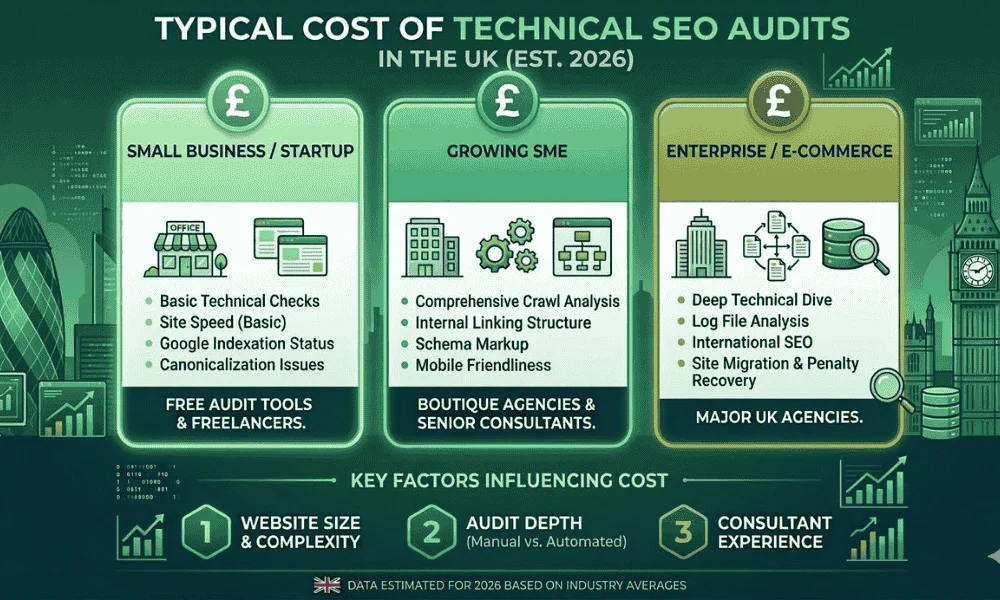
The cost of professional SEO audits varies depending on the size and complexity of the website.
| Audit Type | Estimated Cost | Typical Timeline |
| Basic Audit | £500 – £2,000 | 1–2 Weeks |
| Comprehensive Audit | £2,500 – £7,500 | 2–4 Weeks |
| Enterprise Audit | £7,500 – £15,000 | 4–8 Weeks |
| Ongoing Technical Monitoring | Custom Retainers | Monthly/Quarterly |
Not sure which audit level your website needs?
Many UK businesses discover that a few hidden technical issues are quietly limiting their rankings and lead generation potential. Instead of guessing, get a quick expert review of your site’s technical performance.
Trafficly offers a free 5-minute technical SEO health check where our specialists identify the most critical issues affecting your search visibility and conversions.
Reach out to our experts today
The Technical SEO Checklist for UK Businesses
Every audit ultimately translates findings into a technical SEO checklist for UK businesses that prioritises the most impactful fixes.
Key focus areas include:
- Eliminating 4xx/5xx status codes
- Fixing canonical tag conflicts
- Completing a full site health checkup
- Resolving content cannibalisation fix issues
- Identifying organic growth blockers
- Performing a search visibility audit
This structured approach ensures the most important issues are resolved first.
How Technical SEO Supports Local and National Growth
Technical SEO improvements strengthen the entire digital marketing ecosystem.
Businesses targeting specific locations benefit from combining technical optimisation with Local SEO in UK strategies. Together, these approaches improve visibility in both local search results and organic listings.
Similarly, companies seeking broader online visibility often integrate audits with campaigns from a digital marketing company in UK that can manage SEO, content, and advertising under one strategy.
When technical infrastructure and marketing strategy align, businesses achieve sustainable growth.
The 80/20 Rule: Prioritising Technical Fixes for Maximum ROI
A technical audit typically uncovers dozens of issues. However, not every issue carries the same impact.
Experienced SEO professionals apply the 80/20 rule. This means prioritising the 20 percent of issues that produce 80 percent of the results.
Examples of high-impact fixes include:
- Crawlability errors preventing page indexing
- Slow loading pages damaging conversions
- Major structural navigation issues
Lower priority improvements, such as minor image metadata adjustments, can be addressed later.
This prioritisation ensures that businesses achieve faster SEO ROI.
Why an Audit Alone Is Not Enough
Many companies purchase audits but fail to implement the recommendations. Without execution, even the most detailed report remains a list of problems.
A revenue-driven SEO audit goes beyond diagnostics. It delivers a strategic action plan focused on measurable growth, performance optimization UK standards, and long-term search visibility improvements.
At Trafficly, our approach combines data analysis with a practical implementation roadmap that delivers visible progress within the first 30 days.
FAQs: Technical SEO Audit Services
How often should a technical SEO audit be performed?
Most businesses benefit from a comprehensive audit every 6–12 months, with smaller health checks conducted quarterly to monitor performance changes.
Can technical SEO really improve lead generation?
Yes. Faster websites, better crawlability, and improved search visibility all contribute directly to increased traffic and higher conversion rates.
Do small businesses need technical SEO audits?
Absolutely. Even small websites often contain hidden issues such as duplicate pages, slow loading times, or indexing problems that limit growth.
How long does it take to see results after fixing technical SEO issues?
Many improvements, such as speed optimisation and indexing fixes, can show measurable ranking improvements within weeks.
Ready to Stop Losing Leads?
Technical SEO problems rarely announce themselves loudly. They operate quietly behind the scenes, slowly limiting your website’s visibility and performance.
A comprehensive review of your website’s infrastructure can reveal the exact issues holding your rankings back. More importantly, it creates a roadmap for turning technical improvements into real business growth.
If your website hasn’t undergone a professional review recently, now is the perfect time to evaluate its technical foundation.
Simply send a request to info@trafficly.net and our team will help you explore the next steps toward stronger organic growth.