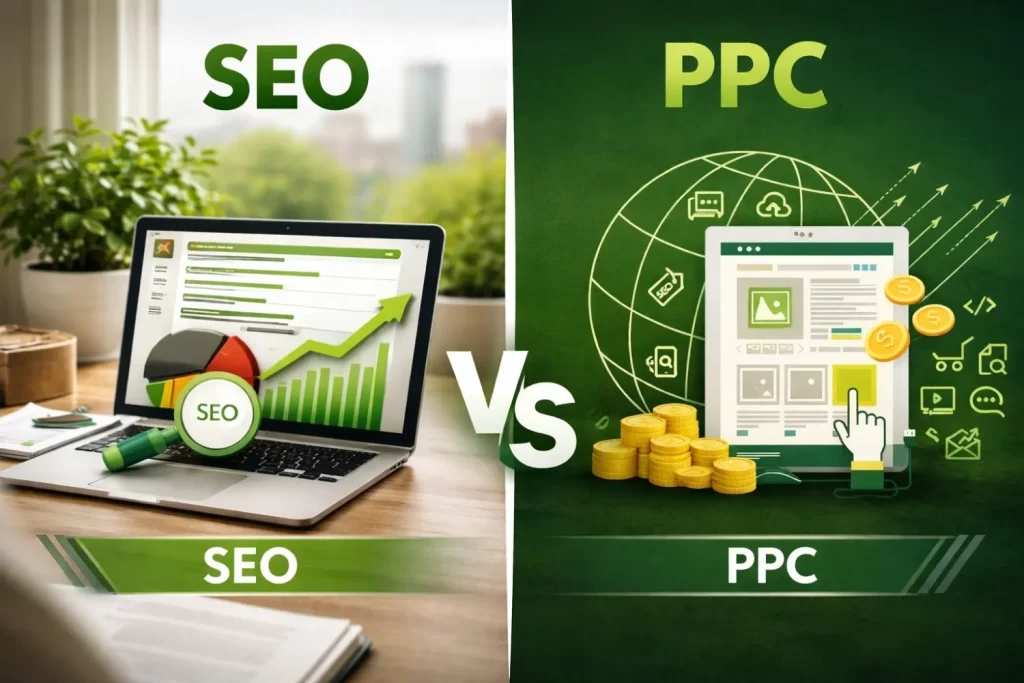
SEO vs. PPC: Which is Better for Manchester Real Estate?
The Manchester property market is moving fast. With average house prices hitting £258,000 in December 2025—a 5.7% year-on-year increase—and private rents climbing to £1,343 per month, the opportunity for estate agents has never been greater . But here’s the challenge every Manchester agency faces: when potential vendors and landlords search Google, will they find you?
The debate around SEO vs. PPC isn’t academic. It directly impacts your pipeline, your profitability, and your market share in a city where 120,000 students feed a graduate retention rate second only to London, and where prime property penthouses now command £7,500–£10,000 monthly rents with gross yields of 6.5–7% .
Need expert guidance on your Manchester real estate digital strategy? Our team specialises in property marketing that delivers qualified leads.
📧 info@trafficly.net
📞 0843 289 3468
The Manchester Property Landscape in 2026: Why Your Digital Strategy Matters Now
Manchester isn’t just growing; it’s transforming. The Office for National Statistics confirms Greater Manchester has experienced the fastest economic growth outside London, driven by two decades of proactive civic leadership. With 100,000 people predicted to be living in the city centre by 2030 and over 10,000 apartments currently in construction, the competition for instructions is fierce .
Yet here’s what keeps agency principals awake at night: Right now commands over 80% of all time spent on UK property platforms, with the average agency branch paying £1,500+ monthly for portal access . That’s a dangerous dependency. As one industry commentator recently warned, agents urgently need alternative marketing channels—exactly what SEO and PPC provide .
The question isn’t whether to invest in digital. It’s how to allocate your budget between organic and paid search for maximum return. Let’s break down the SEO vs. PPC decision with Manchester-specific data and real-world commercial context.
SEO: The Long-Game Strategy for Manchester Estate Agents
Search engine optimisation isn’t about quick wins. It’s about building digital equity that pays dividends long after the work is done. For Manchester agents, this means dominating the organic results when potential vendors search for “estate agents near me” or “property valuation in Didsbury.”
Why Organic Trust Matters More Than Ever
Here’s a psychological reality that shapes buyer behaviour: users trust organic results more than paid advertisements. When a Manchester homeowner searches for “houses for sale in Chorlton,” the organic listings appearing beneath the ads carry an implicit endorsement—Google’s algorithm determined these sites deserve to be there.
This trust differential matters because 92% of buyers read reviews before choosing an agent. Appearing organically for local searches signals legitimacy. It suggests you’re the established player, not just the highest bidder.
Local SEO: Targeting Manchester’s Distinct Neighbourhoods
Manchester isn’t a monolithic market. Someone searching in Altrincham has different expectations from someone looking in Ancoats. The WA15 postcode area commands average sale prices of £553,089, while the M4 postcode in Ancoats averages £276,644 . Your SEO strategy must reflect these micro-markets.
Effective real estate SEO Manchester means creating neighbourhood-specific content that answers real user questions. What’s the school catchment situation in Chorlton? How’s the regeneration progressing in Victoria North? What’s the typical service charge for apartments in Deansgate Square?
This content serves dual purposes. It helps you rank for specific location-based searches, and it demonstrates expertise that converts readers into clients. When you provide genuinely useful information about the Manchester housing market online visibility, you build authority that no paid ad can replicate.
The ROI Mathematics of Long-Term SEO
Let’s talk numbers. A properly executed SEO programme requires investment—typically 3–6 months of content development, technical optimisation, and link building before significant results appear. But once you rank on page one for high-value terms like “estate agents Manchester city centre,” the traffic keeps coming without incremental cost.
Consider the alternative: paying for every click, every month, forever. When you calculate digital marketing ROI for property firms over a three-year horizon, SEO consistently outperforms paid search for sustainable lead generation.
Building Authority Through Backlinks
One reason SEO vs. PPC comparisons favour organic search for long-term value is the compounding effect of backlinks. When local publications, property blogs, or industry sites link to your content, they signal to Google that you’re a trusted authority.
For Manchester agents, this means earning links from Manchester Evening News, local business directories, and property development sites. Each quality backlink strengthens your domain authority, making it easier to rank for competitive terms. The process of building authority through backlinks requires consistent effort—creating shareable content, building relationships with local journalists, and ensuring your property insights are newsworthy enough to earn natural citations.
PPC: The Quick-Win Channel for Competitive Manchester Listings
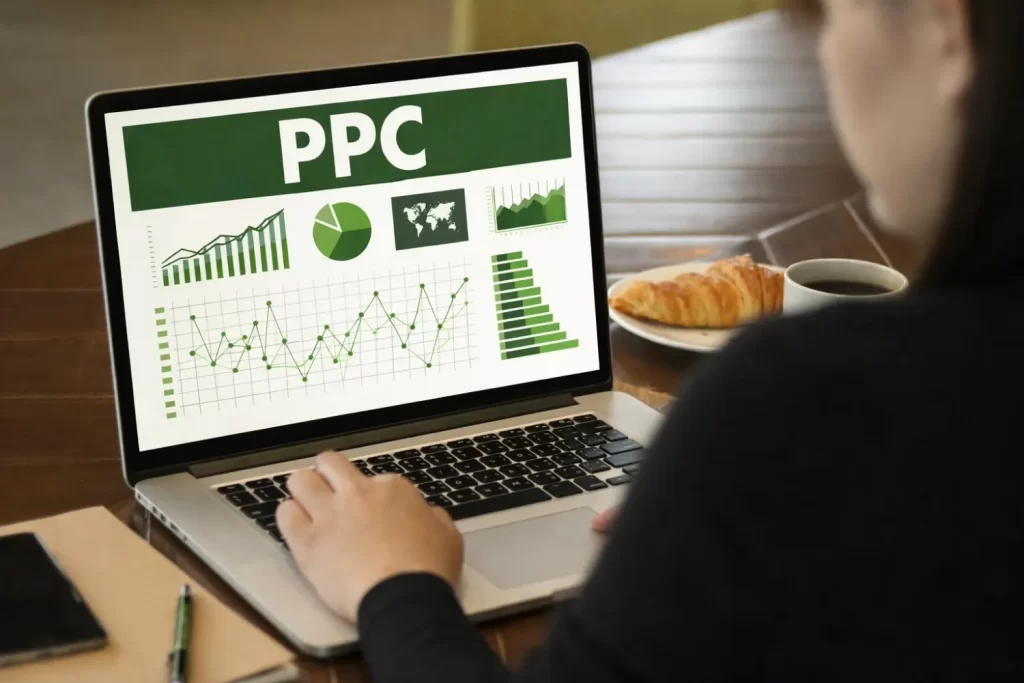
Pay-per-click advertising delivers something SEO cannot: immediate visibility. When you launch a Google Ads campaign today, your ads can appear above organic results within hours. For estate agents facing specific challenges—a new development launch, a slow sales period, or intense competition for a particularly desirable listing—this speed is invaluable.
Understanding Manchester Property PPC Campaign Costs
Let’s be transparent about costs. The average cost-per-click for real estate keywords in the UK sits at approximately £1.82, but Manchester’s competitive landscape pushes that higher for premium terms . Keywords like “estate agents Manchester” or “apartments for sale city centre” attract bids from multiple agencies, corporate chains, and new-build developers.
The key to profitable property PPC campaigns isn’t avoiding high-cost keywords; it’s understanding which clicks actually convert. A £5 click that results in a £5,000 instruction fee is cheap. A 50p click from someone with no intention of moving is expensive, regardless of the nominal cost.
Bidding on Manchester Property Keywords: Strategy Matters
Successful PPC requires granular strategy. You wouldn’t bid the same amount for “property valuation Manchester” (high commercial intent) as you would for “Manchester property market news” (informational intent). Smart bidding means segmenting campaigns by:
- Geographic focus: Separate campaigns for City Centre, South Manchester, and Salford
- Property type: Distinct ad groups for flats, houses, and new developments
- User intent: Different bids for vendors, landlords, and buyers
Negative Keywords: The Hidden Profit Levers
One of the most overlooked elements in Manchester real estate Google Ads is negative keyword management. Without careful exclusions, your ads might show “cheap flats Manchester” when you specialise in luxury apartments, or “student accommodation” when you focus on family homes.
Regular review of search term reports reveals wasted spend. Add irrelevant terms as negative keywords, and your budget stretches further toward genuinely qualified prospects.
Retargeting: Following Interested Users
Here’s where PPC becomes particularly powerful for estate agents. When someone visits your website—perhaps viewing a specific property listing—they’ve demonstrated interest. Retargeting ads keep your agency top-of-mind as they continue browsing.
A potential buyer might look at a Deansgate apartment, get distracted, and return days later. If your retargeting ad appears while they’re reading Manchester Evening News, you’ve just recaptured a lead that might otherwise have gone to a competitor.
The Comparison Matrix: SEO vs. PPC for Manchester Real Estate
| Factor | SEO (Organic Search) | PPC (Paid Ads) |
| Speed to results | 3–6 months for meaningful rankings | Immediate visibility within days |
| Cost structure | High initial investment, declining long-term cost | Ongoing cost per click, stops when budget stops |
| Trust perception | Higher—users trust organic results | Lower—explicitly labelled as advertising |
| Scalability | Compounding returns over time | Linear returns based on budget |
| Local targeting | Excellent for neighbourhood-specific content | Excellent with geographic targeting |
| Ideal for | Building authority, sustainable lead flow | Urgent listings, new developments, precise targeting |
| Manchester context | Essential for “estate agents in [neighbourhood]” searches | Critical for competitive Central Manchester terms |
The Hybrid Approach: Why Manchester’s Most Successful Agents Use Both
Here’s the truth that separates high-performing agencies from the rest: SEO vs. PPC is the wrong framework entirely. The right question is how to integrate both for maximum market dominance.
Combining PPC and SEO strategies creates a digital marketing ecosystem where each channel strengthens the other—paid data informs organic content, while organic authority reduces long-term paid dependency.
Using PPC Data to Inform SEO Strategy
Your PPC campaigns generate invaluable data. Within weeks, you’ll see which keywords drive clicks, which generate enquiries, and which convert to instructions. This data is gold for your SEO strategy.
When you identify high-converting terms through paid search—perhaps “luxury flats Salford Quays” or “family homes Didsbury”—you can prioritise those phrases for organic content development. You’re not guessing what your market wants; you’re following evidence.
Occupying Two Positions on Page One
Consider the search results page for “estate agents Manchester.” When your agency appears both in the paid ads at the top and the organic listings below, you dominate the screen. Competitors are squeezed out. Users see your name twice, reinforcing recognition and authority.
This dual presence is particularly powerful in mobile search, where screen real estate is limited. If you’re not visible in both channels, you’re leaving space for competitors.
Case Study: The Spinningfields Development Scenario
Imagine you’re launching a luxury development in Spinningfields—the kind of scheme attracting the “right-sizing” buyers Savills describes, moving from detached houses in Hale to city-centre penthouses .
Your strategy might look like this:
Phase 1 (Launch): Heavy PPC investment targeting “new apartments Spinningfields,” “luxury penthouses Manchester,” and competitor terms. You need immediate visibility to hit launch targets.
Phase 2 (Sustain): SEO content development around Spinningfields living—restaurant guides, transport links, local amenities. This content builds organic visibility for the long tail of buyers who research before committing.
Phase 3 (Dominate): Retargeting campaigns for everyone who visited your development site but didn’t enquire, combined with organic rankings for “Spinningfields estate agents” that position you as the local expert.
Manchester 2026: Market Context That Shapes Your Strategy
Price Growth and Regional Strength
The North West is projected to be one of the strongest-performing regions in the five years to 2029, with house prices expected to increase by 27.6% compared to the UK average of 22.2% . This growth creates opportunity—more transactions, more vendor instructions, more landlord clients.
Regeneration Hotspots Demand Local Expertise
Major regeneration schemes are reshaping Manchester’s geography. Victoria North, Red Bank, NOMA, and Great Jackson Street represent thousands of new homes and new residents. Agents who establish organic vs paid search for realtors strategies targeting these areas early will dominate as communities develop.
The Rental Market Opportunity
With average rents now at £1,343 monthly and one-bedroom properties commanding £984, the lettings market remains robust . Manchester’s 51% graduate retention rate means thousands of young professionals entering the rental market annually . Local SEO targeting “flats to rent Ancoats” or “apartments to let Salford” captures this demographic at the moment of need.
Practical Implementation: Your Manchester Real Estate Digital Strategy

Month 1–3: Foundation and Quick Wins
Launch PPC campaigns targeting your highest-intent keywords while beginning SEO groundwork. Optimise your Google Business Profile with complete information, photos, and regular posts. Audit your website for technical SEO issues that might limit visibility.
Month 3–6: Build and Refine
Use PPC data to identify which neighbourhoods and property types generate the best enquiries. Develop neighbourhood guides, market updates, and buyer/seller resources targeting these areas. Begin earning backlinks from local Manchester websites and property publications.
Month 6–12: Scale and Dominate
As organic rankings improve, gradually shift budget from broad PPC campaigns to more targeted, retargeting-focused ads. Measure cost per lead: SEO vs Google Ads across both channels, allocating more budget to the most efficient sources. Develop content for emerging regeneration areas before competitors enter.
Frequently Asked Questions
Is Google Ads worth it for UK estate agents?
Yes, when properly managed. Google Ads provides immediate visibility for competitive terms and precise geographic targeting. The key is professional campaign management—without proper structure, negative keywords, and conversion tracking, budgets can waste quickly. For Manchester agents, PPC is particularly valuable for new developments and high-value central postcodes.
How long does SEO take to work for property websites?
Typically 3–6 months before meaningful results appear, though this varies by competition and current website authority. Once established, SEO provides sustainable lead flow without ongoing per-click costs. For Manchester agents targeting competitive terms like “estate agents Didsbury,” patience and consistent effort are essential.
What’s the average cost per click for Manchester property keywords?
Average CPC for real estate keywords nationally is £1.82, but Manchester’s competitive market pushes premium terms higher . Terms like “estate agents Manchester city centre” or “apartments for sale Deansgate” may cost significantly more due to competition from multiple agencies and developers.
Should I stop PPC once SEO ranks?
Not necessarily. The most successful agencies maintain both presences to occupy maximum search real estate. When you appear in both paid and organic results, you dominate the page and build trust through repeated exposure. PPC also allows you to test new keywords and target emerging neighbourhoods faster than SEO alone.
How do I measure success across both channels?
Track source-specific metrics: PPC leads, cost-per-lead, and conversion rates versus organic enquiry volumes and rankings improvements. Use call tracking to attribute phone enquiries correctly. CRM integration showing which channel generated each instruction provides the clearest ROI picture.
Conclusion: The Strategic Answer to SEO vs. PPC
For Manchester real estate, the SEO vs. PPC question has a clear answer: you need both.
PPC delivers the immediate visibility required to compete for today’s instructions, launch new developments, and test market response to different neighbourhoods and property types. It’s your tactical weapon for quick wins and precise targeting.
SEO builds a sustainable authority that reduces your dependence on portals and paid channels over time. It’s your strategic asset for long-term market dominance and cost-efficient lead generation.
The agencies winning Manchester’s most desirable instructions in 2026 will be those who integrate both channels—using PPC data to inform SEO strategy, occupying multiple positions on page one, and building digital assets that compound in value as the city continues its remarkable growth story.
Ready to dominate Manchester search results? Contact our team—a leading digital marketing agency in UK property sector—for a tailored strategy combining SEO and PPC for maximum market impact.
📧 info@trafficly.net | 📞 0843 289 3468